The Bulkhead Pattern: Isolating System Failures
Concept
In distributed architectures, microservices frequently communicate with multiple downstream dependencies, third-party APIs, and databases. Under normal operating conditions, these external calls complete within acceptable latency boundaries. However, when a downstream dependency experiences a partial degradation—such as a slow database query, network packet loss, or thread lock contention—its latency spikes.
Without failure isolation, this latency spike is highly infectious. Modern application runtimes (such as .NET's CLR or Java's JVM) rely on shared thread pools to service incoming HTTP requests and asynchronous tasks. If a controller calls a degraded downstream service, the thread executing that request is blocked (or the asynchronous task remains uncompleted, holding state and queue resources). Under high traffic, all available threads in the shared pool can quickly become trapped waiting for the slow service.
This leads to thread pool starvation, rendering the entire application unresponsive. A failure in a non-critical downstream service (e.g., a recommendation API) cascades to bring down critical pathways (e.g., checkout and user authentication).
Shared Thread Pool (Starved):
[Incoming Requests]
       │
       ├──► [Thread 1] ──(Waiting)──► [Slow Service A]
       ├──► [Thread 2] ──(Waiting)──► [Slow Service A]
       ├──► [Thread 3] ──(Waiting)──► [Slow Service A]
       └──► [Thread N] ──(Waiting)──► [Slow Service A] (No threads left for Service B!)
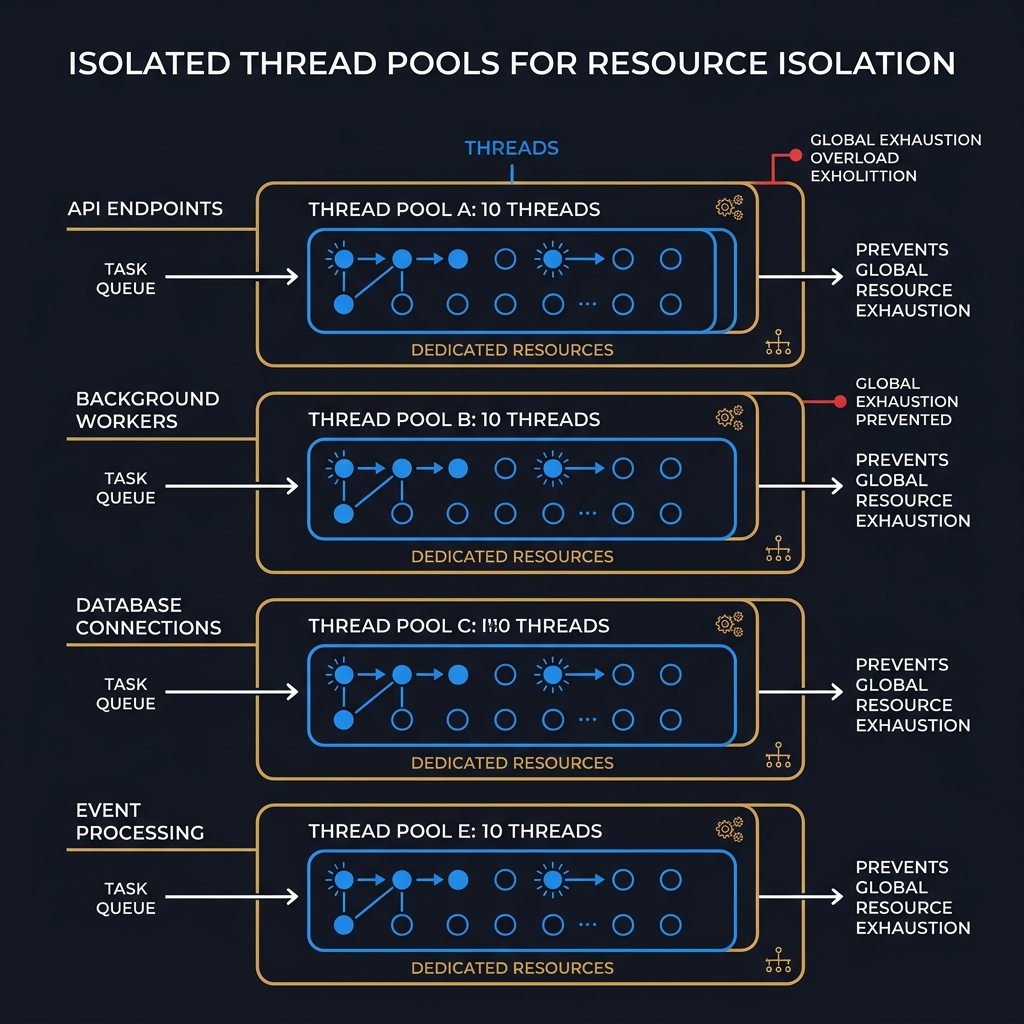
The Bulkhead pattern solves this by partitioning system resources into isolated pools, preventing a failure in one partition from exhausting resources across the entire system. Named after the physical partitions in a ship's hull that prevent the vessel from sinking if a single compartment is breached, the bulkhead pattern establishes strict boundaries for resource allocation.
Bulkhead Partitioned Pools:
[Incoming Requests]
       │
       ├──► [Bulkhead A (Max 10 Threads)] ──► [Slow Service A] (Exhausted, new calls rejected)
       │
       └──► [Bulkhead B (Max 50 Threads)] ──► [Healthy Service B] (Fully operational)
There are two primary models for implementing bulkheads:
- Semaphore-Based Bulkhead: Limits the number of concurrent executions allowed for a specific execution pathway. It utilizes a lightweight counter (like a semaphore) to track active executions. If the limit is reached, incoming requests are immediately rejected or queued up to a specific limit. It does not introduce thread-context switching but relies on the calling thread's pool.
- Thread-Pool-Based Bulkhead: Allocates a dedicated thread pool and execution queue to each downstream dependency. The calling thread hands off the work to the bulkhead's thread pool, decoupling the caller thread pool from downstream latency. If the bulkhead's queue is full, new executions are rejected.
Constraints
When implementing bulkheads, several operational constraints and runtime costs must be considered:
Thread-Pool Allocation Overhead
Dedicated thread pools introduce significant operating system and runtime overhead. Each thread pool incurs a memory cost (e.g., thread stack allocation, typically 1MB per thread in .NET/Windows/Linux by default) and increases CPU overhead due to frequent thread context-switching. If a system manages dozens of downstream dependencies, creating a dedicated thread pool for each can degrade global system performance.
Queue Sizing and Latency (Livelock)
If a bulkhead includes an execution queue, sizing the queue is critical. An excessively large queue allows requests to pile up during downstream degradations, increasing the overall latency of calling clients. By the time a queued task is finally assigned a thread to run, the calling client may have already timed out, leading to wasted work and resource utilization. Conversely, too small a queue leads to aggressive rejection of transient traffic spikes.
Timeout Synchronization
A bulkhead must work in tandem with timeouts. If a task enters a bulkhead queue, the timeout clock must start immediately, not when the task begins execution. If a request has a 5-second SLA, and it spends 4.9 seconds waiting in the bulkhead queue, the downstream invocation must be allocated at most 0.1 seconds, or aborted immediately to prevent useless downstream invocations.
Dynamic Resource Tuning
Static bulkhead sizes (e.g., maximum concurrent executions = 20) fail to adapt to dynamic cloud environments. If a service is scaled out or run on smaller CPU profiles, the optimal bulkhead capacity changes. Underestimating capacity throttles healthy throughput, while overestimating capacity fails to prevent thread starvation.
Trade-offs
Choosing the bulkhead type involves weighing synchronization overhead against isolation guarantees:
| Characteristic | Semaphore-Based Bulkhead | Thread-Pool-Based Bulkhead |
|---|---|---|
| Isolation Depth | Moderate (isolates concurrency, not thread starvation if synchronous blocking occurs) | High (complete isolation of executing threads) |
| Memory Overhead | Extremely Low (lightweight semaphore state) | High (pre-allocated threads and queue structures) |
| Latency Cost | Low (negligible lock-free counter manipulation) | High (context switching, context hand-offs between pools) |
| Use Case | Asynchronous operations (async/await) where threads are not actively blocked. |
Synchronous/blocking legacy library calls that cannot be run asynchronously. |
flowchart TD
    Req[Incoming Request] --> Target{Is downstream call Async/Non-blocking?}
    Target -- Yes --> Sem[Apply Semaphore-Based Bulkhead]
    Target -- No --> Pool[Apply Thread-Pool-Based Bulkhead]

    Sem --> ExecSem{Semaphore Available?}
    ExecSem -- Yes --> Run1[Execute Call]
    ExecSem -- No --> QueueSem{Queue Space Available?}
    QueueSem -- Yes --> WaitSem[Queue & Wait]
    QueueSem -- No --> RejectSem[Reject Request: Bulkhead Full]

    Pool --> RunPool{Thread Pool Free?}
    RunPool -- Yes --> Run2[Execute Call on Pool]
    RunPool -- No --> QueuePool{Queue Space Available?}
    QueuePool -- Yes --> WaitPool[Queue & Wait]
    QueuePool -- No --> RejectPool[Reject Request: Queue Full]
Code
Below is a production-grade, thread-safe implementation of a Semaphore-Based Bulkhead with queue capacity limits in C#. It uses SemaphoreSlim to limit concurrency and a concurrent queue count tracked via lock-free Interlocked operations to reject requests when both concurrency and queue spaces are saturated.
using System;
using System.Threading;
using System.Threading.Tasks;

namespace ResiliencyPatterns
{
    public class BulkheadRejectedException : Exception
    {
        public BulkheadRejectedException(string message) : base(message) { }
    }

    public interface IBulkheadPolicy
    {
        Task<T> ExecuteAsync<T>(Func<CancellationToken, Task<T>> action, CancellationToken cancellationToken);
    }

    public class BulkheadPolicy : IBulkheadPolicy
    {
        private readonly SemaphoreSlim _semaphore;
        private readonly int _maxQueueCapacity;
        private int _currentQueueCount = 0;

        public int MaxConcurrency { get; }
        public int MaxQueueCapacity => _maxQueueCapacity;
        public int QueueCount => _currentQueueCount;
        public int AvailableSlots => _semaphore.CurrentCount;

        public BulkheadPolicy(int maxConcurrency, int maxQueueCapacity)
        {
            if (maxConcurrency <= 0)
                throw new ArgumentOutOfRangeException(nameof(maxConcurrency), "Concurrency must be greater than zero.");
            if (maxQueueCapacity < 0)
                throw new ArgumentOutOfRangeException(nameof(maxQueueCapacity), "Queue capacity cannot be negative.");

            MaxConcurrency = maxConcurrency;
            _maxQueueCapacity = maxQueueCapacity;
            _semaphore = new SemaphoreSlim(maxConcurrency, maxConcurrency);
        }

        public async Task<T> ExecuteAsync<T>(Func<CancellationToken, Task<T>> action, CancellationToken cancellationToken)
        {
            // 1. Fast Path: Check if we can enter the semaphore immediately without waiting
            if (_semaphore.Wait(0, CancellationToken.None))
            {
                try
                {
                    return await action(cancellationToken);
                }
                finally
                {
                    _semaphore.Release();
                }
            }

            // 2. Slow Path: Concurrency full, check if queue capacity is saturated
            while (true)
            {
                int currentQueue = Volatile.Read(ref _currentQueueCount);
                if (currentQueue >= _maxQueueCapacity)
                {
                    throw new BulkheadRejectedException(
                        $"Execution rejected. Bulkhead concurrency limit '{MaxConcurrency}' and queue capacity '{_maxQueueCapacity}' exceeded."
                    );
                }

                // Attempt to increment the queue counter atomically
                if (Interlocked.CompareExchange(ref _currentQueueCount, currentQueue + 1, currentQueue) == currentQueue)
                {
                    break;
                }
            }

            try
            {
                // Wait for the semaphore slot with cooperative cancellation support
                await _semaphore.WaitAsync(cancellationToken);
            }
            finally
            {
                // Decrement queue counter as the task is moving out of the queue and into execution
                Interlocked.Decrement(ref _currentQueueCount);
            }

            try
            {
                // Execute the actual callback
                return await action(cancellationToken);
            }
            finally
            {
                _semaphore.Release();
            }
        }
    }
}