Securing Edge Gateways: OAuth2 and OIDC Token Validation
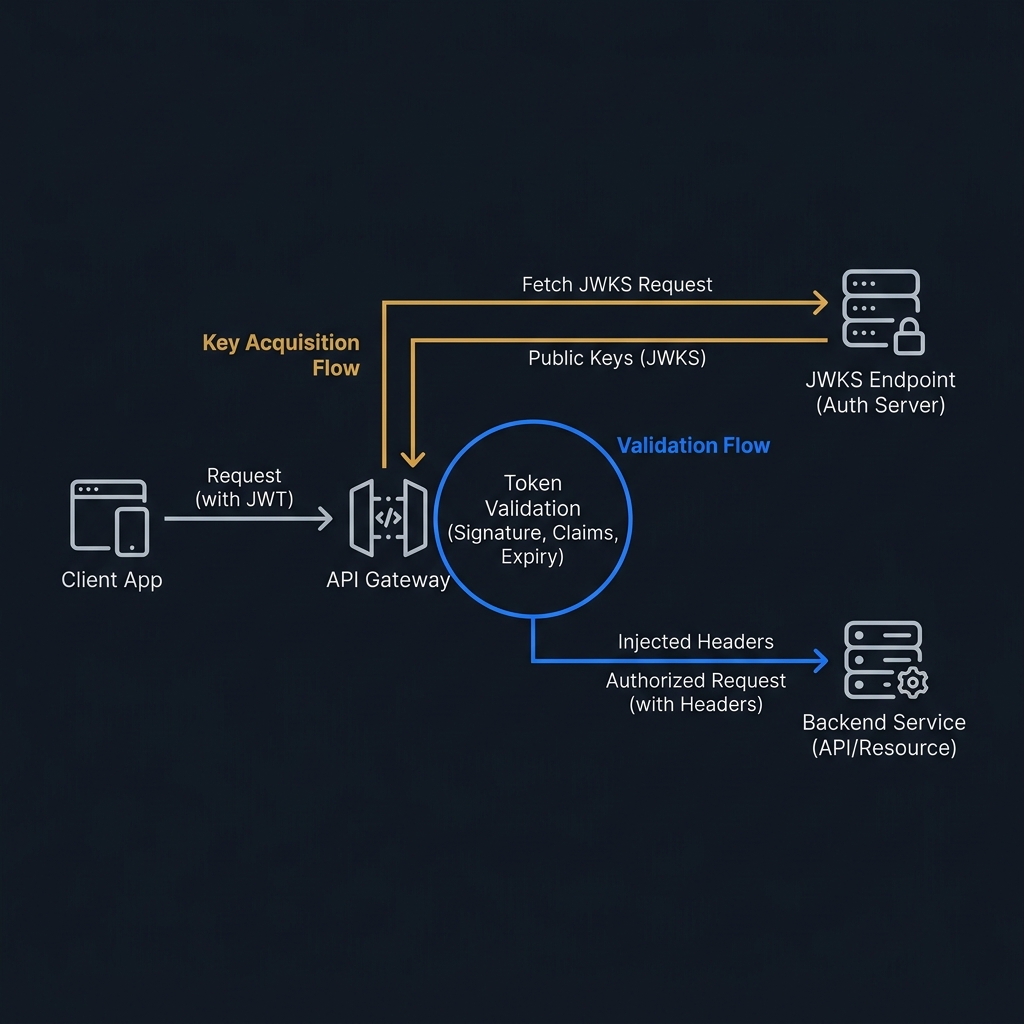
Enforcing security policies at the system entry point is critical. We analyze how API gateways validate JWTs, manage cache-based JWKS keys, and forward identity context to downstream services.
Concept
In modern distributed architectures, the API Gateway acts as the entry point for all client requests. Rather than delegating authentication to each individual microservice—which increases surface vulnerability and duplicates code—security policies are enforced at the perimeter.
Using OAuth2 and OpenID Connect (OIDC), the API Gateway functions as a Policy Enforcement Point (PEP). It intercepts incoming client requests, extracts and validates JSON Web Tokens (JWTs), and forwards authenticated user contexts to downstream services. This article covers edge token validation, mapping to the curriculum in Module 13: Edge Gateways, Security, & Traffic Shaping.
Client ──[ HTTPS Request + Bearer JWT ]──> API Gateway (PEP)
                                                │
          ┌─────────────────────────────────────┴─────────────────────────────────────┐
          │  1. Fetch / Cache JWKS Public Keys from IdP (OIDC Endpoint)              │
          │  2. Validate Cryptographic Signature (RS256/ES256)                        │
          │  3. Verify Claims (exp, iss, aud)                                         │
          │  4. Extract User ID and Roles                                             │
          └─────────────────────────────────────┬─────────────────────────────────────┘
                                                │
                                                ▼
                   ──[ HTTP Request + X-User-Id & X-User-Roles Headers ]──> Downstream Services
The Validation Workflow
The API Gateway follows a structured validation sequence for every incoming request:
- Extraction: The gateway inspects the HTTP
Authorizationheader, validating that it contains aBearertoken scheme. - Signature Verification (JWKS): The signature of a JWT is cryptographically signed by the Identity Provider (IdP) using a private key. The gateway verifies the signature using the IdP's public key. The IdP exposes these public keys at a standard JSON Web Key Set (JWKS) endpoint. The gateway dynamically retrieves and caches these keys, matching the key ID (
kid) header in the incoming JWT. - Claims Validation: The gateway checks the payload claims:
exp(Expiration Time): Must be in the future.iss(Issuer): Must match the configured IdP domain.aud(Audience): Must match the gateway's registered client ID.nbf(Not Before): Must be in the past.
- Downstream Context Propagation: Once verified, the gateway decodes the JWT's claims (such as
subfor user ID androlesfor permissions) and injects them into the HTTP headers of the forwarded request (e.g.,X-User-Id,X-User-Roles).
Constraints
Architects must address performance and security constraints when performing cryptographic validation at high throughput.
1. Cryptographic Verification Overhead
Validating a signature requires CPU cycles, particularly for asymmetric algorithms like RSA (e.g., RS256).
- Throughput Constraint: If the gateway validates the cryptographic signature of every incoming request from scratch using raw CPU threads, the system's maximum request-per-second (RPS) capacity drops significantly.
- Mitigation: Employ JWT caching or session tokens. By caching the validation result of a JWT hash in a local, fast-access memory store (like L1 memory with a short TTL), the gateway can skip cryptographic decoding for subsequent requests within the cache window.
2. JWKS Latency and Key Rotation
Keys in the JWKS are occasionally rotated by the IdP for security compliance or in response to a key compromise.
- Network Lag Constraint: If the gateway queries the JWKS endpoint synchronously on every request, it introduces high latency.
- Cache Invalidation Hazard: If the gateway caches the JWKS indefinitely, a key rotation will result in all subsequent valid tokens failing validation (since the gateway is using outdated public keys). The cache must support automatic invalidation, querying the IdP if it encounters an unknown
kid(up to a rate-limited threshold to prevent DoS attacks).
3. Header Injection and Spoofing
Downstream services trust the headers injected by the API Gateway.
- Security Constraint: If the gateway does not scrub incoming headers, a malicious client could bypass authentication by sending a request containing custom headers like
X-User-Id: admin-user. - Mitigation: The gateway must sanitize and overwrite all
X-User-*headers from incoming client requests before routing them downstream.
Trade-offs
Securing the edge involves balancing token structures, performance overheads, and downstream network trust.
1. Reference Tokens (Opaque) vs. Value Tokens (JWT)
- Value Tokens (JWT): Contain the user state encoded directly in the string.
- Trade-off: Self-contained and scalable; the gateway does not need to query the database to know who the user is. However, they are difficult to revoke before their expiration time (
exp) without maintaining a distributed blacklist.
- Trade-off: Self-contained and scalable; the gateway does not need to query the database to know who the user is. However, they are difficult to revoke before their expiration time (
- Reference Tokens (Opaque): Contain a random identifier (e.g., UUID). The gateway must query a database or cache (like Redis) on every request to look up the associated user context.
- Trade-off: Enables instant token revocation. However, it introduces database network latency and creates a stateful dependency at the gateway layer.
2. Edge Trust vs. Zero-Trust Downstream Validation
- Edge Trust (Single Verification Point): The gateway validates the token and injects simple headers. Downstream microservices assume any incoming traffic is valid and secure.
- Trade-off: High performance and simple microservice code. However, if an attacker gains access to the internal network (perimeter breach), they can spoof headers to access any microservice unchecked.
- Zero-Trust Validation (Mutual TLS / Internal JWT): The gateway validates the external token and generates a short-lived, signed internal token (or forwards the original JWT). Downstream services use mutual TLS (mTLS) and cryptographically validate the token again.
- Trade-off: High security. However, it increases processing latency and CPU utilization across all internal service nodes.
Implementation: Custom YARP JWT Gateway Transform in C#
The following C# code demonstrates how to implement a custom YARP (Yet Another Reverse Proxy) request transform. It intercepts incoming requests, validates a JWT using a cached token validation configuration, and safely injects user identities into downstream headers while stripping incoming client-spoofed headers.
using System;
using System.IdentityModel.Tokens.Jwt;
using System.Security.Claims;
using System.Threading.Tasks;
using Microsoft.AspNetCore.Http;
using Microsoft.IdentityModel.Tokens;
using Yarp.ReverseProxy.Transforms;

namespace Mpc.Gateway.Security
{
    public class JwtValidationTransform : RequestTransform
    {
        private readonly TokenValidationParameters _validationParameters;
        private readonly JwtSecurityTokenHandler _tokenHandler;

        public JwtValidationTransform(TokenValidationParameters validationParameters)
        {
            _validationParameters = validationParameters ?? throw new ArgumentNullException(nameof(validationParameters));
            _tokenHandler = new JwtSecurityTokenHandler();
        }

        public override async ValueTask ApplyAsync(RequestTransformContext context)
        {
            // 1. Sanitize/scrub any incoming client-spoofed headers to prevent injection attacks
            context.ProxyRequest.Headers.Remove("X-User-Id");
            context.ProxyRequest.Headers.Remove("X-User-Roles");

            // 2. Extract authorization header
            var authHeader = context.HttpContext.Request.Headers["Authorization"].ToString();
            if (string.IsNullOrEmpty(authHeader) || !authHeader.StartsWith("Bearer ", StringComparison.OrdinalIgnoreCase))
            {
                // Let the request pass through unauthenticated (downstream may allow anonymous)
                // or block it by returning a 401 response directly.
                return;
            }

            var token = authHeader.Substring("Bearer ".Length).Trim();

            try
            {
                // 3. Cryptographically validate the token and check claims
                var principal = _tokenHandler.ValidateToken(token, _validationParameters, out var validatedToken);

                if (principal != null)
                {
                    // Extract subject (User ID) and roles from token claims
                    var userId = principal.FindFirst(ClaimTypes.NameIdentifier)?.Value
                                 ?? principal.FindFirst("sub")?.Value;

                    var roles = principal.FindFirst(ClaimTypes.Role)?.Value
                                ?? principal.FindFirst("roles")?.Value;

                    // 4. Inject validated security context into downstream headers
                    if (!string.IsNullOrEmpty(userId))
                    {
                        context.ProxyRequest.Headers.Add("X-User-Id", userId);
                    }
                    if (!string.IsNullOrEmpty(roles))
                    {
                        context.ProxyRequest.Headers.Add("X-User-Roles", roles);
                    }
                }
            }
            catch (SecurityTokenException)
            {
                // Fail-closed: Block request immediately at the edge if a token is present but invalid
                context.HttpContext.Response.StatusCode = StatusCodes.Status401Unauthorized;
                await context.HttpContext.Response.WriteAsync("Invalid or expired authentication token.");

                // Terminate proxy forwarding
                context.HttpContext.Items["TokenValidationError"] = true;
            }
        }
    }
}