Preventing Retry Storms: Exponential Backoff and Jitter Design
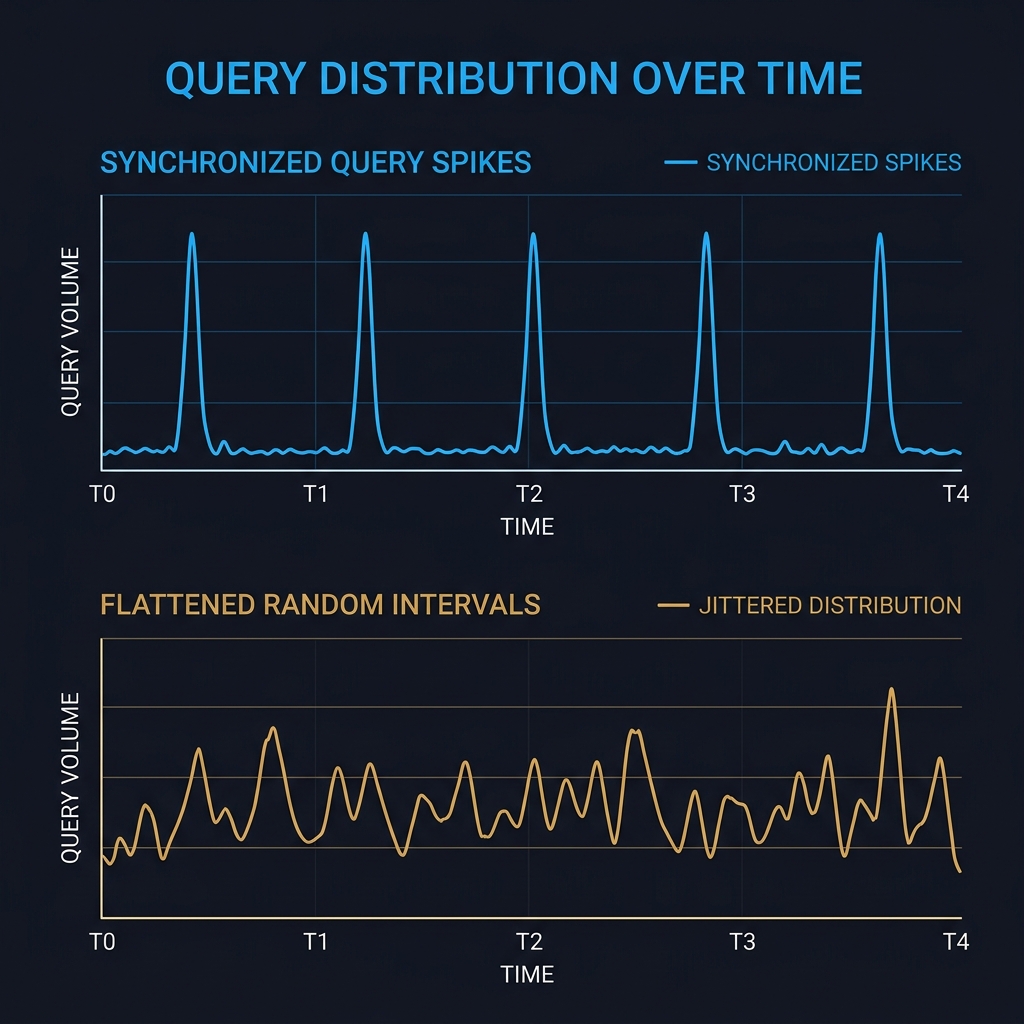
Naively retrying failed requests can trigger a retry storm, further degrading a recovering service. We design a robust retry policy utilizing exponential backoff and randomized jitter.
Concept
In distributed systems, transient network glitches, database lock contentions, and temporary server overloads are common failure modes. Standard architectural guidance dictates that client applications should automatically retry failed operations. However, if clients apply a naive retry policy—such as retrying immediately or waiting a static duration (e.g., exactly 1 second) between attempts—they run the risk of generating a retry storm.
A retry storm is a self-inflicted Distributed Denial of Service (DDoS) attack. When a downstream service experiences a brief hiccup, multiple requests fail simultaneously. If all client instances retry at identical intervals, their request cycles synchronize. This synchronization generates intense spikes of traffic that hit the downstream service in recurring waves.
Synchronized Retries (Retry Storm):
Traffic Spikes
   ▲
   │      █                 █                 █
   │      █                 █                 █
   │      █                 █                 █
   │──────█─────────────────█─────────────────█────── (Service capacity)
   │     Retry             Retry             Retry
   │     Wave 1            Wave 2            Wave 3
   └──────────────────────────────────────────────────► Time
If the downstream service was attempting to recover from a high load, these synchronized retry waves overwhelm it again, pushing it back into failure. The system oscillates between overloaded failure and idle recovery, extending a short-lived transient error into a prolonged, cyclical outage.
To prevent this pattern, systems must deploy two primary algorithmic techniques:
1. Exponential Backoff
Exponential backoff increases the delay between retry attempts progressively, scaling exponentially to prevent clogging the network. The maximum delay is bound by a ceiling value. The base formula for the delay on attempt $i$ is:
$$t_{backoff} = \min(t_{max}, t_{base} \cdot c^{i})$$
Where:
- $t_{base}$ is the initial backoff interval (e.g., 100ms).
- $c$ is the growth multiplier (typically 2.0).
- $i$ is the zero-indexed retry attempt.
- $t_{max}$ is the upper boundary ceiling (e.g., 10 seconds).
2. Randomization (Jitter)
Exponential backoff alone does not prevent synchronization; it only spreads the synchronized waves further apart in time. If 100 requests fail at the exact same millisecond, they will still retry at the exact same millisecond, 2 seconds later. Jitter introduces random noise into the backoff delay to break up this synchronization.
There are three main jitter algorithms, popularized by AWS:
Full Jitter: The sleep duration is a random value chosen uniformly between 0 and the calculated exponential backoff limit. $$t_{sleep} = \text{random}(0, t_{backoff})$$ This provides the highest reduction in peak request density.
Equal Jitter: A portion of the backoff is kept constant, and the remaining portion is randomized. This ensures a minimum delay while still scattering requests. $$t_{half} = \frac{t_{backoff}}{2}$$ $$t_{sleep} = t_{half} + \text{random}(0, t_{half})$$
Decorrelated Jitter: The sleep duration is calculated by introducing randomness based on the previous sleep duration. This is highly effective when client clocks are not synchronized and allows the retry window to expand dynamically. $$t_{sleep} = \min(t_{max}, \text{random}(t_{base}, t_{prev} \cdot 3))$$
Constraints
Architects must navigate several low-level runtime and design constraints when building retry policies:
Socket and Connection Exhaustion
Holding onto a client request during backoff delays consumes system sockets, thread allocations, and memory. If a client retries 5 times with exponential backoff up to 10 seconds, the active HTTP connection is kept open. Under high volume, this can lead to socket exhaustion (exhausting ephemeral ports) on the client side, causing subsequent outbound connections to fail before they even leave the host.
Distributed Call Chains (Fan-out Amplification)
If Service A calls Service B, which calls Service C, and all services implement nested retries, an error in Service C triggers a multiplication of requests. If each layer retries 3 times, a single client request to Service A can amplify into $3 \times 3 = 9$ calls to Service C. Retries must be placed carefully—ideally only at the entry point of the call chain or bound by retry budgets that limit retries to a small fraction (e.g., 5-10%) of total traffic.
Idempotency Requirements
Retrying non-idempotent operations (such as credit card processing or mutating POST requests) is dangerous. If a request times out, the client cannot know if the server processed the transaction before the network connection dropped. Retries must only be executed on idempotent operations (like GET, PUT, or DELETE requests that explicitly handle idempotency keys).
Sleep Precision and Clock Drift
Standard system timers (such as Thread.Sleep or Task.Delay in C#) do not have microsecond precision. On some operating systems, scheduling delays can drift by 15ms or more. Jitter calculations must account for the scheduler's resolution to ensure the randomization is not smoothed over by OS scheduler quantum intervals.
Trade-offs
Choosing the appropriate retry and jitter configuration requires balancing API responsiveness with downstream safety:
| Jitter Type | Peak Load Reduction | Client Latency Variance | Resource Holding Cost | Implementation Complexity |
|---|---|---|---|---|
| No Jitter | Poor (synchronized waves) | Low (deterministic delays) | Low | Low |
| Equal Jitter | Moderate | Moderate | Moderate | Medium |
| Full Jitter | Excellent (flat distribution) | High (can retry immediately or wait max) | High | Medium |
| Decorrelated Jitter | Excellent | High (progressive drift) | High | High |
graph TD
    A[Request Fails] --> B{Is failure transient?}
    B -- No --> C[Fail Fast / Propagate Error]
    B -- Yes --> D{Is operation idempotent?}
    D -- No --> C
    D -- Yes --> E{Retry Budget Saturated?}
    E -- Yes --> C
    E -- No --> F[Calculate Exponential Backoff]
    F --> G{Select Jitter Algorithm}
    G -- Full Jitter --> H[Random 0 to Max Backoff]
    G -- Equal Jitter --> I[Base Half Backoff + Random Half]
    G -- Decorrelated --> J[Random Base to Prev Sleep * 3]
    H & I & J --> K[Await Jittered Sleep]
    K --> L[Retry Request]
Code
The following C# code provides a thread-safe, allocation-efficient implementation of a Retry Engine supporting both Full Jitter and Decorrelated Jitter algorithms. It features a lock-free retry budget tracking system to prevent clients from executing retries if the local success rate drops below 90%.
using System;
using System.Security.Cryptography;
using System.Threading;
using System.Threading.Tasks;

namespace ResiliencyPatterns
{
    public enum JitterStrategy
    {
        Full,
        Decorrelated
    }

    public class RetryBudget
    {
        private long _totalRequests = 0;
        private long _retryAttempts = 0;

        public void RegisterRequest() => Interlocked.Increment(ref _totalRequests);
        public void RegisterRetry() => Interlocked.Increment(ref _retryAttempts);

        public bool AllowRetry()
        {
            var total = Volatile.Read(ref _totalRequests);
            var retries = Volatile.Read(ref _retryAttempts);

            if (total < 100) return true; // Bootstrap phase

            // Enforce that retries represent less than 10% of total system calls
            double retryRatio = (double)retries / total;
            return retryRatio < 0.10;
        }
    }

    public class RobustRetryEngine
    {
        private readonly int _maxRetries;
        private readonly TimeSpan _baseDelay;
        private readonly TimeSpan _maxDelay;
        private readonly JitterStrategy _strategy;
        private readonly RetryBudget _budget;

        public RobustRetryEngine(
            int maxRetries,
            TimeSpan baseDelay,
            TimeSpan maxDelay,
            JitterStrategy strategy,
            RetryBudget budget)
        {
            _maxRetries = maxRetries;
            _baseDelay = baseDelay;
            _maxDelay = maxDelay;
            _strategy = strategy;
            _budget = budget ?? throw new ArgumentNullException(nameof(budget));
        }

        public async Task<T> ExecuteAsync<T>(
            Func<CancellationToken, Task<T>> operation,
            Func<Exception, bool> isTransient,
            CancellationToken cancellationToken)
        {
            TimeSpan prevSleep = _baseDelay;

            for (int attempt = 0; attempt <= _maxRetries; attempt++)
            {
                _budget.RegisterRequest();

                try
                {
                    return await operation(cancellationToken);
                }
                catch (Exception ex) when (isTransient(ex) && attempt < _maxRetries && _budget.AllowRetry())
                {
                    _budget.RegisterRetry();

                    TimeSpan delay = CalculateDelay(attempt, prevSleep);
                    prevSleep = delay;

                    await Task.Delay(delay, cancellationToken);
                }
            }

            throw new InvalidOperationException("Retry limits or retry budget exceeded.");
        }

        private TimeSpan CalculateDelay(int attempt, TimeSpan prevSleep)
        {
            double randomDouble = GetRandomDouble();

            if (_strategy == JitterStrategy.Full)
            {
                // Full Jitter: Sleep = random(0, min(MaxDelay, BaseDelay * 2^attempt))
                double backoffMs = Math.Min(_maxDelay.TotalMilliseconds, _baseDelay.TotalMilliseconds * Math.Pow(2, attempt));
                double sleepMs = randomDouble * backoffMs;
                return TimeSpan.FromMilliseconds(sleepMs);
            }
            else
            {
                // Decorrelated Jitter: Sleep = min(MaxDelay, random(BaseDelay, PrevSleep * 3))
                double minMs = _baseDelay.TotalMilliseconds;
                double maxMs = Math.Min(_maxDelay.TotalMilliseconds, prevSleep.TotalMilliseconds * 3);

                // Keep ordering intact
                if (maxMs < minMs) maxMs = minMs;

                double sleepMs = minMs + (randomDouble * (maxMs - minMs));
                return TimeSpan.FromMilliseconds(sleepMs);
            }
        }

        private double GetRandomDouble()
        {
            // Cryptographically secure random double between 0.0 and 1.0 (prevents seed collision across threads)
            byte[] bytes = new byte[8];
            RandomNumberGenerator.Fill(bytes);
            ulong value = BitConverter.ToUInt64(bytes, 0);
            return (double)(value & 0x001FFFFFFFFFFFFFUL) / (1UL << 53);
        }
    }
}