Manual W3C Traceparent Header Parsing and Context Propagation
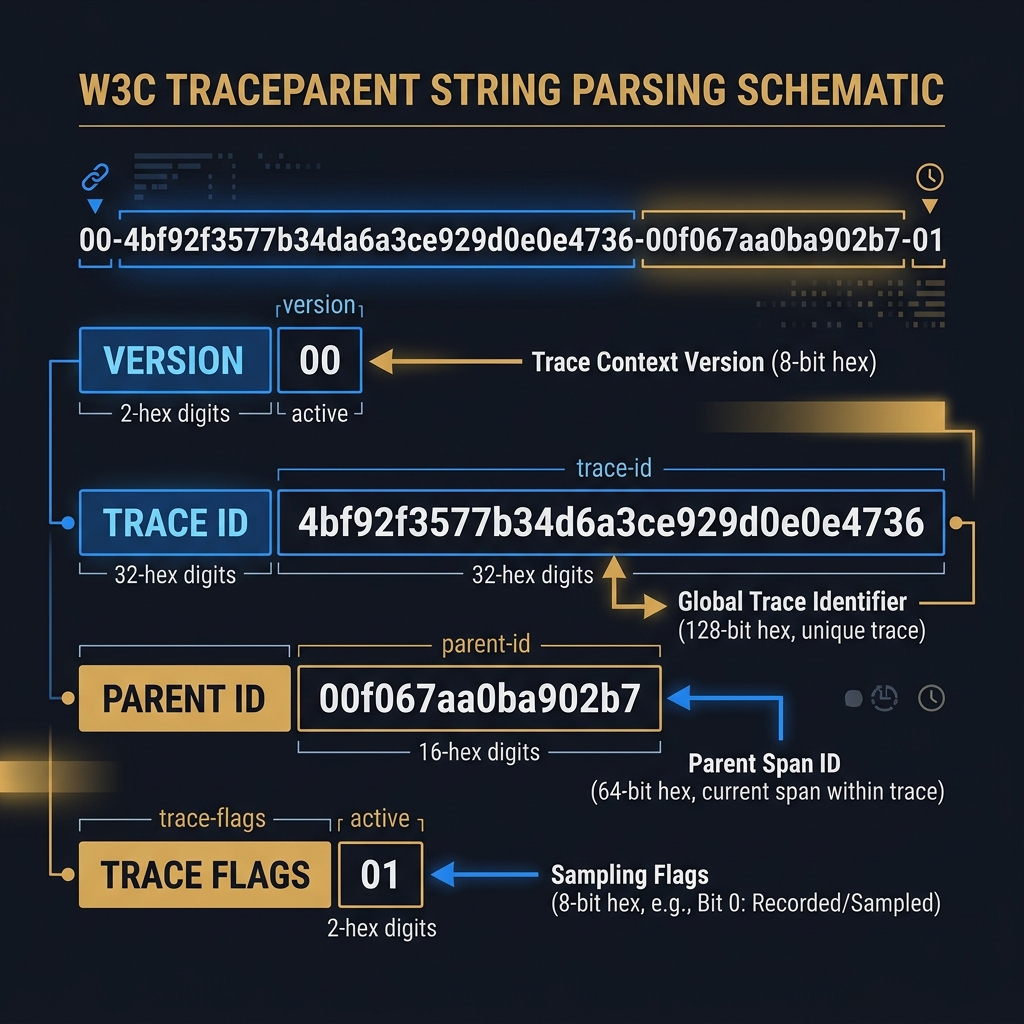
Understanding distributed tracing requires looking under the hood of context propagation. We manually parse the W3C traceparent HTTP header in C# to propagate telemetry context.
Concept
In a distributed microservice architecture, a single user request can trigger a cascading tree of downstream RPC calls, database queries, and message broker publish-subscribe events. Troubleshooting performance bottlenecks or tracking error root-causes across service boundaries is impossible without distributed tracing.
Distributed tracing relies on Context Propagation. As a request flows through the system, metadata representing the unique request tree (the trace context) is serialized and injected into the transport headers (typically HTTP headers) of outbound calls. Downstream services extract this header, deserialize the trace context, associate their local operations (spans) with it, and propagate it further down the call graph.
To ensure observability tools from different vendors can interoperate, the World Wide Web Consortium (W3C) established the W3C Trace Context Specification. This standard defines two primary HTTP headers: traceparent and tracestate.
The traceparent header is a single, hyphen-delimited string of 55 characters containing exactly four positional fields:
W3C Traceparent String Breakdown:
00-4bf92f3577b34da6a3ce929d0e0e4736-00f067aa0ba902b7-01
│  │                                │                │
│  │                                │                └── Trace Flags (8 bits / 2 hex) -> 01 = Sampled
│  │                                └─────────────────── Parent Span ID (64 bits / 16 hex)
│  └──────────────────────────────────────────────────── Trace ID (128 bits / 32 hex)
└─────────────────────────────────────────────────────── Version (8 bits / 2 hex)
- Version (8 bits / 2 hex characters): The version of the trace context specification being used. Currently, the only supported version is
00. - Trace ID (128 bits / 32 hex characters): A globally unique identifier for the entire transaction chain. It cannot be all zeros.
- Parent ID / Span ID (64 bits / 16 hex characters): The unique identifier of the specific parent operation that initiated the current request. It cannot be all zeros.
- Trace Flags (8 bits / 2 hex characters): Bitwise flags controlling telemetry behavior. The least significant bit (bit 0) represents the Recorded/Sampled flag. If set to
1(01), the transaction was selected for tracing, and downstream services should record spans. If set to0(00), the transaction is unsampled, but context must still be propagated.
While high-level SDKs like OpenTelemetry handle this parsing automatically, understanding and manually parsing the traceparent header is critical when building lightweight API Gateways, custom reverse proxies, edge serverless functions (where library overhead is restricted), or when integrating legacy systems that do not support the full OpenTelemetry SDK.
Constraints
Building a manual parser for W3C traceparents requires meeting strict W3C specification criteria and low-level performance guidelines:
Strict Validation Rules
The W3C specification dictates that any invalid traceparent header must be discarded entirely. Validations include:
- The header must be exactly 55 characters long for version
00. - Hyphen delimiters (
-) must occupy index positions 2, 35, and 52. - All characters must be valid lowercase hexadecimal digits (
0-9anda-f). Uppercase hex is invalid. - The
Trace IDmust not consist entirely of zeros (00000000000000000000000000000000). - The
Parent IDmust not consist entirely of zeros (0000000000000000). - If the parser encounters a version greater than
00(e.g.,01), it must still attempt to parse the first four fields using the version00layout rather than failing, to ensure forward compatibility.
Zero-Allocation Performance
Context propagation occurs on every single incoming HTTP request in high-throughput applications. A manual parser must not allocate objects on the garbage-collected heap. Using standard string manipulation APIs like string.Split('-') or regular expressions (Regex) creates temporary string objects and array allocations. Under millions of requests per second, this triggers intense GC pressure, degrading application throughput. The parser must process the input string as a read-only character span (ReadOnlySpan<char>) and parse hex values directly into stack-allocated structures.
Thread Safety and Context Scope
Once parsed, the trace context must be bound to the asynchronous execution flow of the current request. In C#, this requires leveraging AsyncLocal<T> to ensure the trace context flows across thread transitions during async/await operations, preventing context leaks between concurrent user requests.
Trade-offs
Choosing between custom parsing and importing full OpenTelemetry SDKs requires balancing performance budgets with developer velocity:
| Aspect | Custom Manual Parsing | OpenTelemetry SDK |
|---|---|---|
| Footprint / Dependency Bloat | Zero external dependencies, minimal binary size. | Dozens of package dependencies, large assembly footprint. |
| Execution Speed | Extremely fast (microsecond parsing using stack spans). | Moderate (general-purpose processing pipelines). |
| Memory Allocation | Zero heap allocations. | Small but recurring heap allocations (unless heavily tuned). |
| Compliance Maintenance | Developer must manually track and update spec changes. | Automatically maintained by the open-source community. |
| Telemetry Exporting | Requires custom exporter logic to forward spans. | Rich suite of built-in exporters (Otlp, Zipkin, Prometheus). |
graph TD
    A[Incoming HTTP Request] --> B{Has 'traceparent' header?}
    B -- No --> C[Generate New Trace ID & Parent ID]
    B -- Yes --> D{Is length exactly 55?}
    D -- No --> E{Is version > 00?}
    E -- Yes --> F[Parse first 55 chars, ignore trailing]
    E -- No --> G[Discard Header, Generate New Context]
    D -- Yes --> H{Check hyphens at 2, 35, 52?}
    H -- No --> G
    H -- Yes --> I{Verify hex lowercase?}
    I -- No --> G
    I -- Yes --> J{Check Trace ID / Parent ID not all zeros?}
    J -- No --> G
    J -- Yes --> K[Parse version, traceId, parentId, flags]
    K --> L[Store in AsyncLocal context]
    C --> L
Code
Below is a high-performance, zero-allocation C# parser for the W3C Traceparent header. It uses ReadOnlySpan<char> and stack-based parsing to process headers without heap allocations or regex. It includes full spec-compliant validation and hooks into an AsyncLocal-based propagation scope.
using System;
using System.Globalization;

namespace Observability
{
    public readonly struct TraceContext
    {
        public string Version { get; }
        public string TraceId { get; }
        public string ParentSpanId { get; }
        public bool IsSampled { get; }

        public TraceContext(string version, string traceId, string parentSpanId, bool isSampled)
        {
            Version = version;
            TraceId = traceId;
            ParentSpanId = parentSpanId;
            IsSampled = isSampled;
        }
    }

    public static class TraceContextPropagation
    {
        private static readonly AsyncLocal<TraceContext?> CurrentContext = new();

        public static TraceContext? Current => CurrentContext.Value;

        public static void SetCurrentContext(TraceContext context)
        {
            CurrentContext.Value = context;
        }

        /// <summary>
        /// Compliant W3C traceparent parser using ReadOnlySpan to prevent heap allocations.
        /// </summary>
        public static bool TryParseTraceparent(string? headerValue, out TraceContext context)
        {
            context = default;
            if (string.IsNullOrWhiteSpace(headerValue)) return false;

            ReadOnlySpan<char> span = headerValue.AsSpan().Trim();

            // Spec requirement: Minimum length for version '00' is 55 characters
            if (span.Length < 55) return false;

            // Validate hyphen delimiters
            if (span[2] != '-' || span[35] != '-' || span[52] != '-') return false;

            // Extract fields as spans
            ReadOnlySpan<char> versionSpan = span.Slice(0, 2);
            ReadOnlySpan<char> traceIdSpan = span.Slice(3, 32);
            ReadOnlySpan<char> parentIdSpan = span.Slice(36, 16);
            ReadOnlySpan<char> flagsSpan = span.Slice(53, 2);

            // Validate hex characters are lowercase
            if (!IsLowercaseHex(versionSpan) ||
                !IsLowercaseHex(traceIdSpan) ||
                !IsLowercaseHex(parentIdSpan) ||
                !IsLowercaseHex(flagsSpan))
            {
                return false;
            }

            // Spec requirement: Reject all-zero Trace ID or Parent ID
            if (IsAllZeros(traceIdSpan) || IsAllZeros(parentIdSpan))
            {
                return false;
            }

            string version = versionSpan.ToString();

            // For version '00', length must be exactly 55. If version is higher, we permit length > 55
            if (version == "00" && span.Length != 55)
            {
                return false;
            }

            string traceId = traceIdSpan.ToString();
            string parentSpanId = parentIdSpan.ToString();

            // Parse flags (bit 0 represents the sampling decision)
            if (!byte.TryParse(flagsSpan, NumberStyles.HexNumber, CultureInfo.InvariantCulture, out byte flagsByte))
            {
                return false;
            }

            bool isSampled = (flagsByte & 0x01) == 0x01;

            context = new TraceContext(version, traceId, parentSpanId, isSampled);
            return true;
        }

        private static bool IsLowercaseHex(ReadOnlySpan<char> span)
        {
            foreach (char c in span)
            {
                if (!((c >= '0' && c <= '9') || (c >= 'a' && c <= 'f')))
                {
                    return false;
                }
            }
            return true;
        }

        private static bool IsAllZeros(ReadOnlySpan<char> span)
        {
            foreach (char c in span)
            {
                if (c != '0') return false;
            }
            return true;
        }
    }
}